For hospital emergency-department teams
Salem: ED Coordination
The physician faces the patient, not the screen.
Salem is a coordination layer above the hospital information system. It shows who is responsible for each patient and task, which results still need follow-up, which alerts are open, and what is handed over at each shift change. It never replaces the hospital information system.
What Salem is
Rescue first
Resuscitation and urgent bedside assessment never wait for a registration, a scan, a network connection, a specialist reply or a risk score. Emergency temporary identity is always available.
Responsibility you can see
Each patient and task shows its accountable owner. When nobody holds a role or a task, Salem shows the gap instead of inventing an owner.
Unknown stays visible
Missing, stale or conflicting data stays on screen instead of being hidden. No alert does not mean no danger.
Built for the bedside
Scan a patient slip or a specimen container, or type the code. A scan is never treated as clinical confirmation. Actions taken offline stay visibly pending until the server confirms them.
Decision support that stays advice
Where a hospital enables decision-support agents, every suggestion shows its sources and is labelled “Suggestion — not an order. Physician must review.” Suggestions appear only after the hospital’s clinical owner signs off in writing on that exact agent version. The physician always decides.
One hospital, one environment
Each hospital has its own database, encryption key and sign-in, with multi-factor authentication. Patient data is never used to train AI models. No ads, analytics or tracking.
The workflow in five steps
One synthetic patient, followed from arrival to shift handover.
Every screenshot shows fictional data from “Synthetic Hospital A” (records prefixed SYN-). No real patient appears on this site.
-
Step 1
The visit and its team
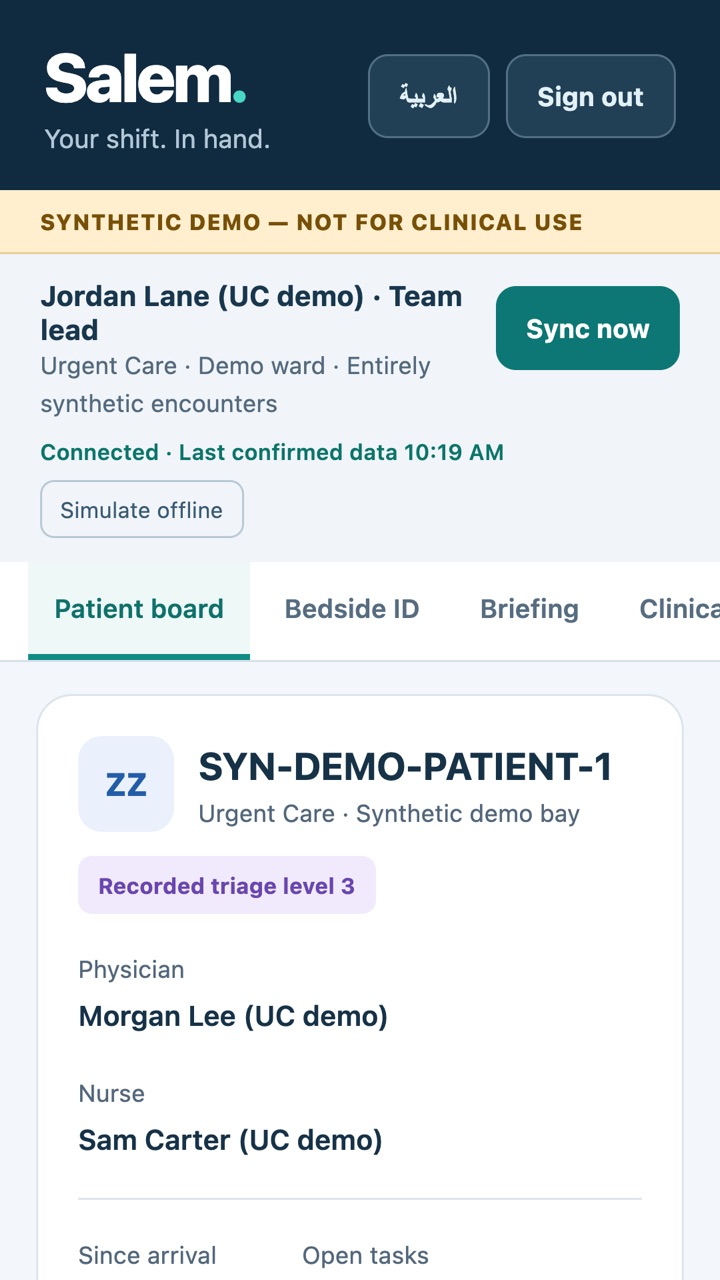
One clear visit: registered from its source, with an accepted physician and nurse
The patient board shows each visit with its recorded acuity, the physician and nurse who accepted it, the time since arrival and its open tasks.
-
Step 2
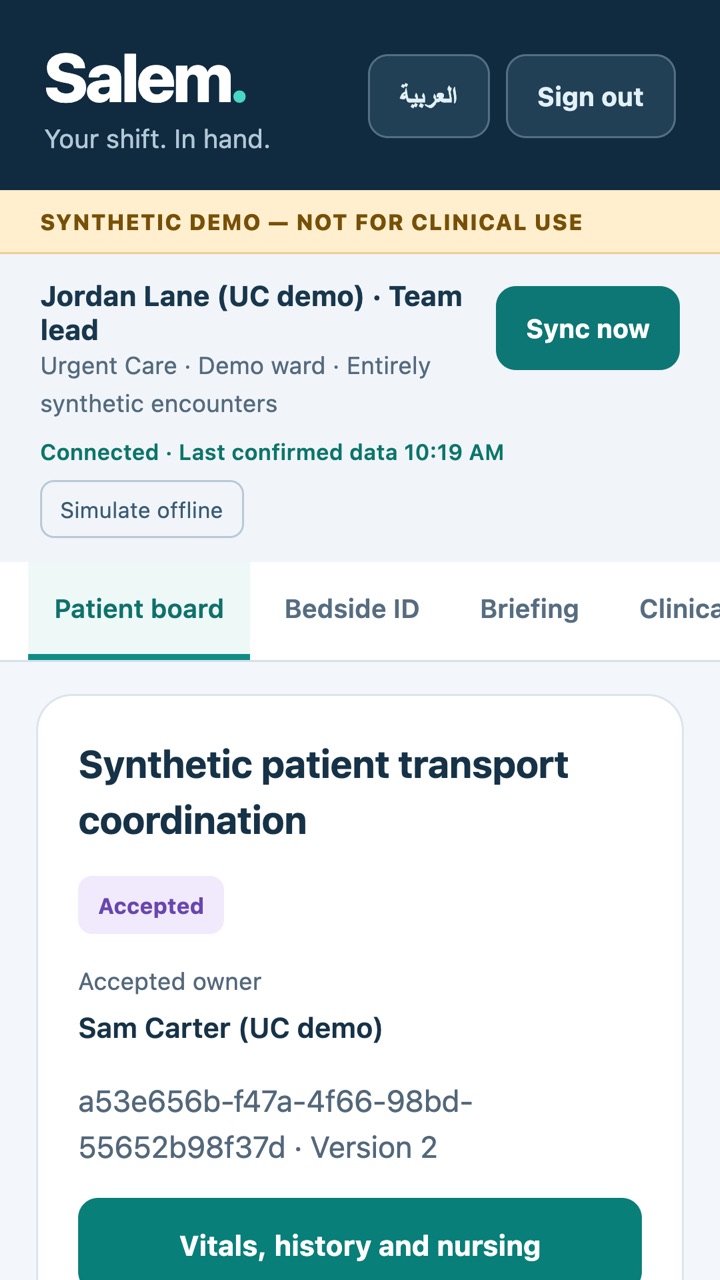
One owner for each task
One accountable owner, only after the recipient accepts
Ownership moves only when the recipient accepts an offer. When nobody holds a task, Salem shows the gap instead of inventing an owner.
-
Step 3
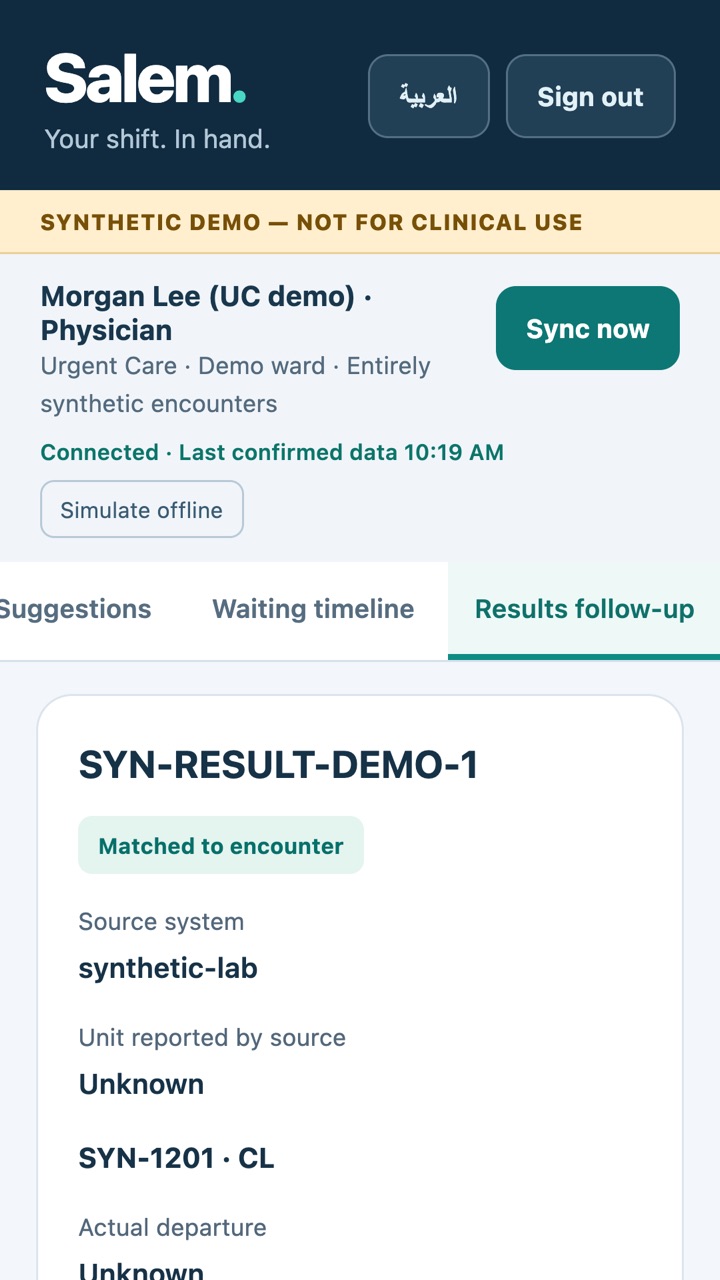
Results that stay followed
A result follow-up bound to its source and exact revision
Each follow-up is bound to its source result and its exact revision. An unmatched or changed result stays visible until a physician reviews it.
-
Step 4
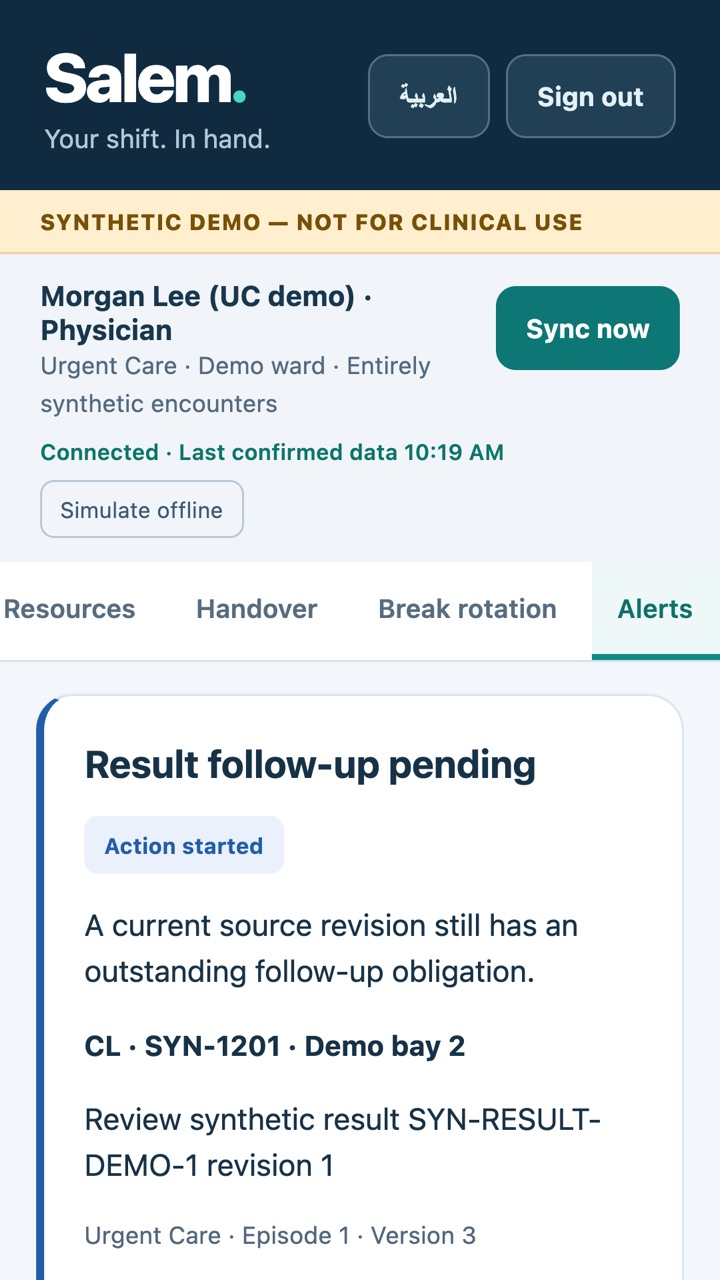
Alerts with honest states
Acknowledged is not resolved: the alert stays open until the work is done
Sent, delivered to a device, acknowledged, reviewed and completed are separate states. Acknowledging records awareness; the alert closes only when the work behind it is done.
-
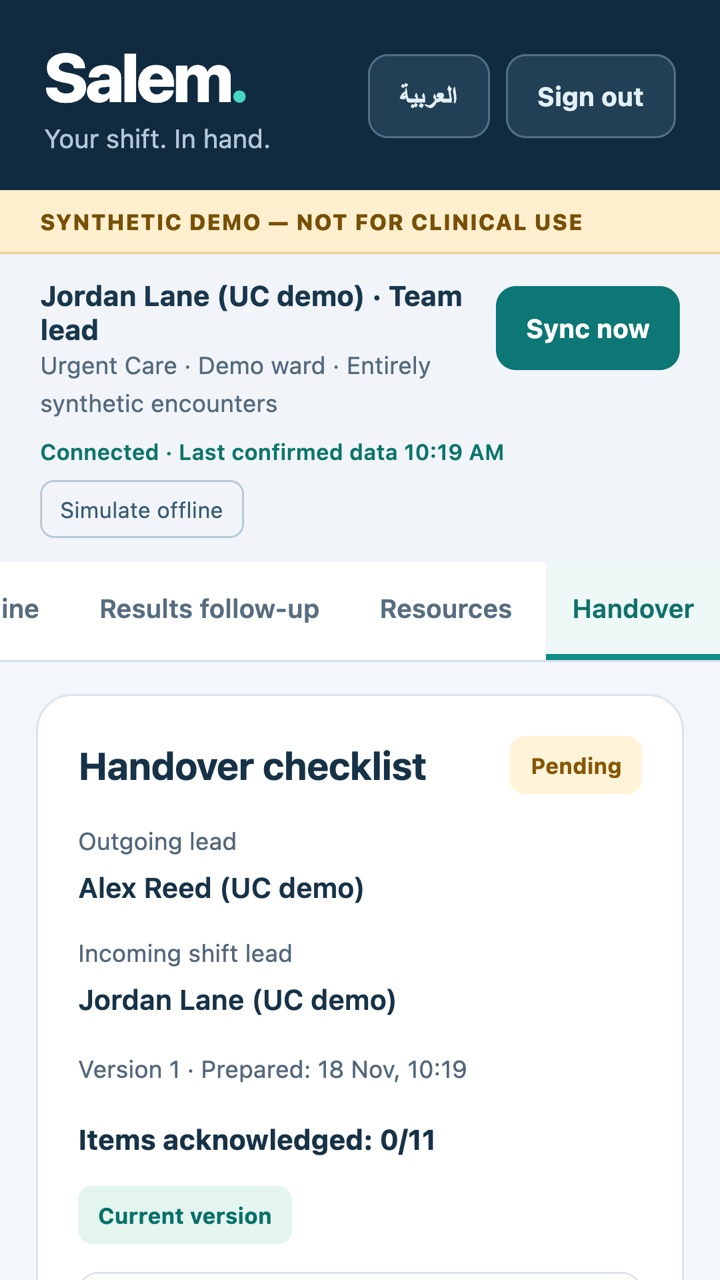
Step 5
Handover that never reassigns
Handover lists the open work and never reassigns it
The handover checklist lists the open work for the incoming lead. Acknowledging an item never changes who owns a patient or a task.
Founder
Abdullah Janab M Alruwaili
Resident physician, Emergency Department
Founder of Salem and sole originator of its six-layer architecture (F0–F6).
Patent application No. SA 1020268345, filed 21/09/2026, passed formal examination. The founder is the applicant and sole inventor.
Contact
Salem is built for hospital emergency departments. To discuss Salem for your department, write to us.
- General enquiries
- support@drjnab.com
- Privacy
- privacy@drjnab.com
- Report a security concern
- security@drjnab.com
Please do not send patient information by email.